What Is Canthal Tilt? How to Measure Yours
The eye angle that quietly shapes how attractive your face looks
What is canthal tilt?
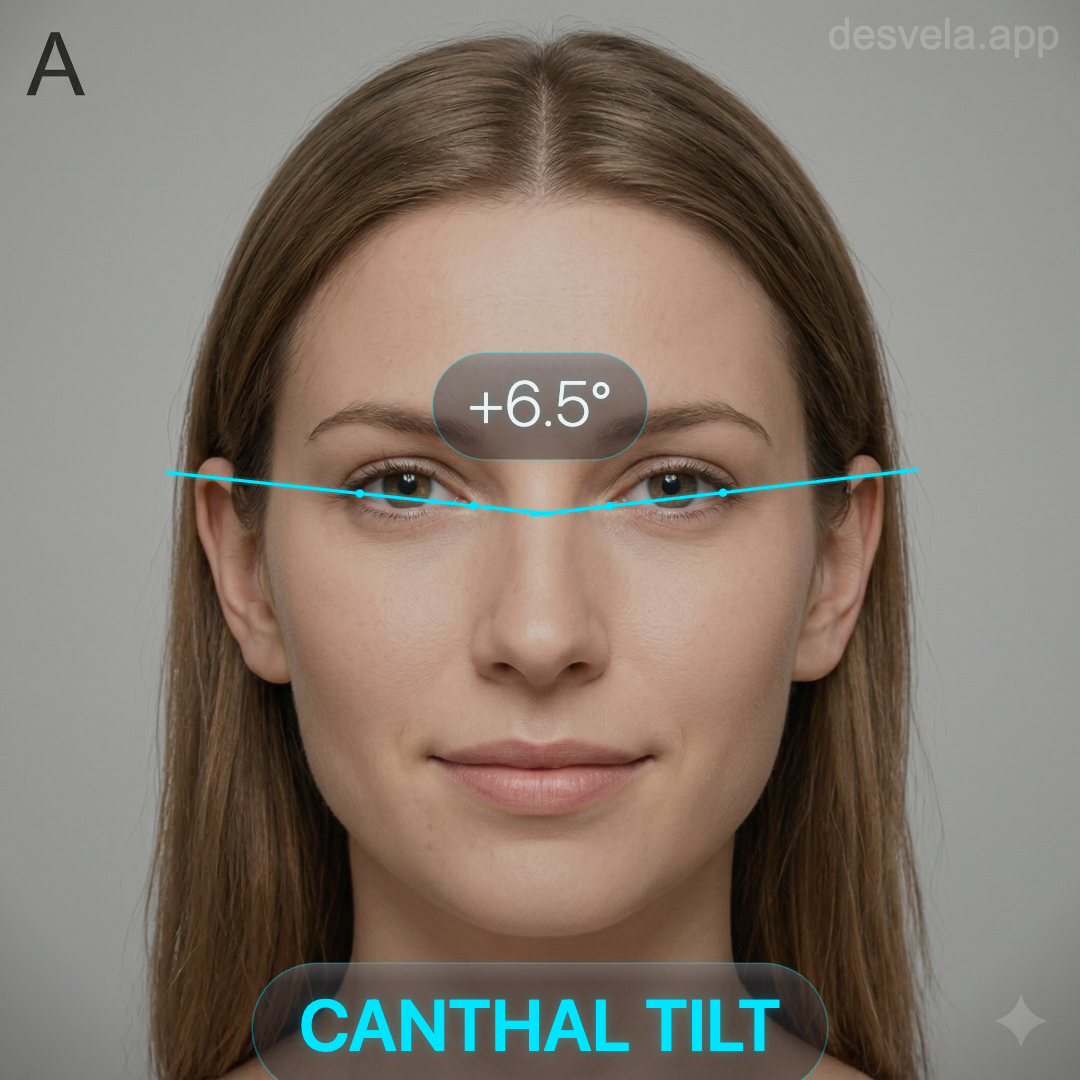
Canthal tilt is the angle formed between the inner corner of your eye (the medial canthus) and the outer corner (the lateral canthus), measured relative to the horizontal plane. If your outer corner sits higher than your inner corner, you have a positive canthal tilt. If the outer corner sits lower, that's a negative canthal tilt. If they're level, your canthal tilt is neutral.
This single measurement has an outsized effect on facial perception. A positive canthal tilt gives the eyes an upswept, alert look that's associated with youth and attractiveness across most cultures. A negative tilt can create a tired or downturned appearance, even when the rest of the face is well-proportioned.
Why does canthal tilt matter?
Research in evolutionary psychology suggests that eye geometry is one of the first things people process when reading a face. The eyes convey emotion, health, and age faster than any other feature. Canthal tilt contributes to whether the eyes appear "lifted" or "drooped," and this impression forms in milliseconds.
In women, a slightly positive canthal tilt (typically 4–7 degrees) is associated with higher attractiveness ratings in cross-cultural studies. This is one reason why cosmetic techniques like the "fox eye" look, winged eyeliner, and lateral brow lifts are so popular — they all simulate a more positive canthal tilt.
For men, the effect is subtler. A neutral-to-slightly-positive tilt is typical for masculine faces. Very strong positive tilts can read as overly feminine, while negative tilts can convey fatigue or age.
How is canthal tilt measured?
In clinical settings, canthal tilt is measured with calipers or from standardized photographs using the angle between a line connecting the medial and lateral canthi and the true horizontal. The result is expressed in degrees.
Desvela measures canthal tilt using MediaPipe's 468-point facial landmark detection. The algorithm identifies the precise pixel positions of your inner and outer eye corners and calculates the angle between them. Because this is done from a front-facing photo (not a clinical setup), we calibrate our baselines specifically for this measurement context.
The measurement is taken separately for each eye. Desvela reports the average of left and right canthal tilt, and the scoring accounts for the fact that some natural asymmetry between eyes is completely normal.
What's a "good" canthal tilt?
There's no single ideal value — it depends on your ethnicity, sex, and the rest of your facial geometry. East Asian women typically have a more positive canthal tilt (5–8 degrees) compared to White / European women (3–5 degrees). South Asian and Black / African populations fall in between.
Desvela uses ethnicity-calibrated baselines to score your canthal tilt relative to your reference population. A 5-degree tilt might score 85/100 for one group and 70/100 for another, because the relevant comparison group is different.
Park et al. (2020) documented significant variation in canthal tilt across Korean subjects, confirming that population-specific norms are essential for meaningful scoring. This is why one-size-fits-all beauty calculators miss the mark.
Can you change your canthal tilt?
Canthal tilt is primarily determined by your orbital bone structure and the ligaments that anchor the corners of your eyes. It can shift slightly with age as the lateral canthal ligament loosens, which is why older faces tend to develop a more negative tilt over time.
Non-surgical options include strategic eyeliner application (winged liner lifts the perceived outer corner), brow shaping (a higher lateral brow creates the illusion of a more positive tilt), and certain tape techniques used in East Asian beauty communities.
Surgical options include lateral canthoplasty (tightening or repositioning the outer corner) and brow lifts. These are meaningful procedures and should only be considered after thorough consultation with a qualified surgeon.
How Desvela scores canthal tilt
Canthal tilt is one of four active metrics in Desvela's Zone 3 (Sexual Dimorphism). It's scored using a Gaussian decay function that penalizes deviation from your personalized baseline mean. Small deviations barely affect your score; large deviations are progressively more costly.
You can tap the canthal tilt metric in your results to see a diagnostic overlay — green lines drawn directly on your photo showing the exact angle measured for each eye. This makes the measurement tangible and verifiable, not a black box.
Key takeaways
Canthal tilt is a small measurement with a big impact on perceived attractiveness. It's one of the first things people unconsciously register about your eyes, and it varies significantly across ethnicities. Understanding your canthal tilt — and how it compares to your reference population — gives you actionable information for both makeup strategy and understanding your facial geometry.