Facial Symmetry: What Science Actually Says
It's not about perfection — it's about what asymmetry reveals
The symmetry hypothesis
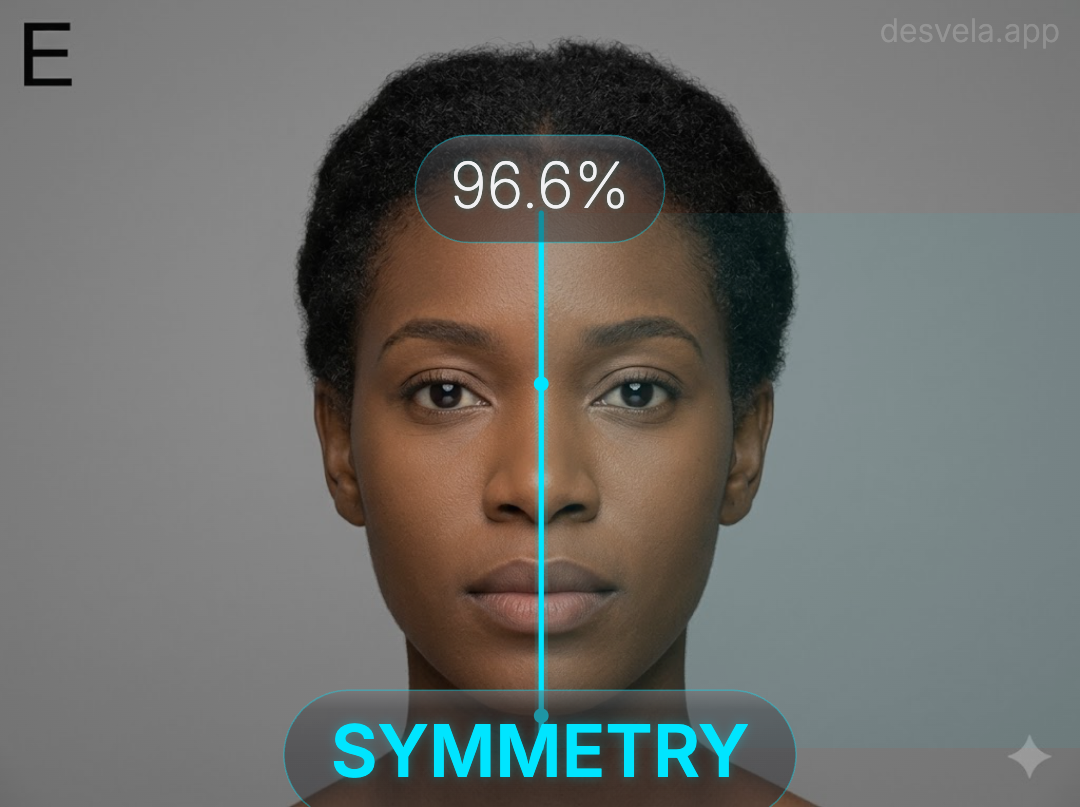
The idea is simple: symmetrical faces are more attractive. This hypothesis has been one of the most studied claims in evolutionary psychology, and the research behind it is more nuanced than the headline suggests.
Gillian Rhodes' influential 2006 review in the Annual Review of Psychology surveyed decades of research and confirmed that symmetry is consistently correlated with attractiveness ratings across cultures. The proposed mechanism is developmental stability — the ability of an organism to develop normally despite genetic and environmental stress. A symmetrical face, the theory goes, signals that your development was resilient.
But perfect symmetry looks wrong
Here's the paradox: when researchers create perfectly symmetrical faces by mirroring one half, people rate them as less attractive than the original asymmetric face. Perfect bilateral symmetry looks artificial, uncanny, and slightly unsettling.
What humans actually prefer is near-symmetry — faces where the left and right sides are close but not identical. The most attractive faces in Rhodes' studies had low asymmetry, not zero asymmetry. This makes sense intuitively: everyone has minor asymmetries, and we're calibrated to read them as natural.
This is why the popular "mirror test" (covering half your face to see which side looks better) is misleading. Each half of your face interacts with the other to create your complete appearance. Analyzing halves in isolation misses the point.
How is facial symmetry measured?
Clinical measurement involves identifying corresponding landmark pairs on the left and right sides of the face — the corners of the eyes, the edges of the nose, the corners of the mouth, the jaw angles — and calculating how much each pair deviates from the vertical midline.
The most common metric is the average absolute deviation across all landmark pairs, sometimes normalized by face size. Farkas et al. (2005) established that different populations have different typical asymmetry levels, so meaningful measurement requires population-specific baselines.
In AI-based measurement, landmark detection models like MediaPipe identify these points automatically. However, there's a significant limitation: these models are trained on photographs and tend to "smooth" landmarks toward symmetry. This means AI-detected symmetry from photos is consistently more symmetric than the actual face, especially under controlled lighting.
Why Desvela hides symmetry scores (for now)
We tested symmetry scoring extensively against two datasets: 424 faces from the Chicago Face Database (studio photographs with controlled lighting) and 22 real-world selfies from various lighting conditions and camera angles.
The results were clear: MediaPipe's landmark detection does not reliably measure bilateral asymmetry under real-world conditions. On studio photos, the model smooths landmarks toward symmetry, producing inflated scores. On phone selfies, uneven lighting, hair occlusion, and JPEG compression cause the model to hallucinate severe asymmetry that doesn't exist.
Our validation showed a correlation of just r = 0.05 between symmetry scores and independent attractiveness ratings — essentially random. Rather than showing users a number that doesn't mean anything, we chose transparency: Zone 1 (Foundation) displays "Coming Soon" until we can implement a reliable measurement approach.
What actually drives symmetry perception?
Recent research suggests that what people perceive as "asymmetry" is often driven by skin texture and tone uniformity rather than skeletal landmark positions. Uneven pigmentation, acne scarring, or differences in skin texture between sides of the face are much more visually salient than a 1mm difference in eye corner position.
This is why Desvela is developing a skin homogeneity metric for Zone 1 — analyzing texture and tone consistency rather than relying on landmark-based bilateral comparison. This approach should produce scores that actually correlate with what humans perceive as facial symmetry.
What symmetry can't tell you
Symmetry is one factor among many. A highly symmetrical face with unfavorable proportions or low sexual dimorphism will still score lower on attractiveness than a slightly asymmetric face with strong proportions and dimorphism. Rhodes herself noted that symmetry explains only a small percentage of variance in attractiveness ratings.
This is exactly why Desvela uses a multi-zone approach instead of a single composite score. Symmetry (when reliably measured) gives you one piece of information. Proportions, dimorphism, and feature detail give you the rest — and often the more actionable pieces.
Practical implications
If you're concerned about facial asymmetry, the most impactful changes usually involve soft tissue and presentation rather than skeletal structure. Hairstyle and parting direction, eyebrow shaping, contouring and highlighting, and even which side of your face you favor in photos can all shift the perception of symmetry significantly.
Understanding which of your features are asymmetric — and whether that asymmetry is visually significant — is more useful than a single symmetry percentage. That's the kind of diagnostic information Desvela aims to provide once our measurement is reliable enough to trust.