Face Width-to-Height Ratio (fWHR): What It Means
The metric that connects face shape to perceived dominance and femininity
What is fWHR?
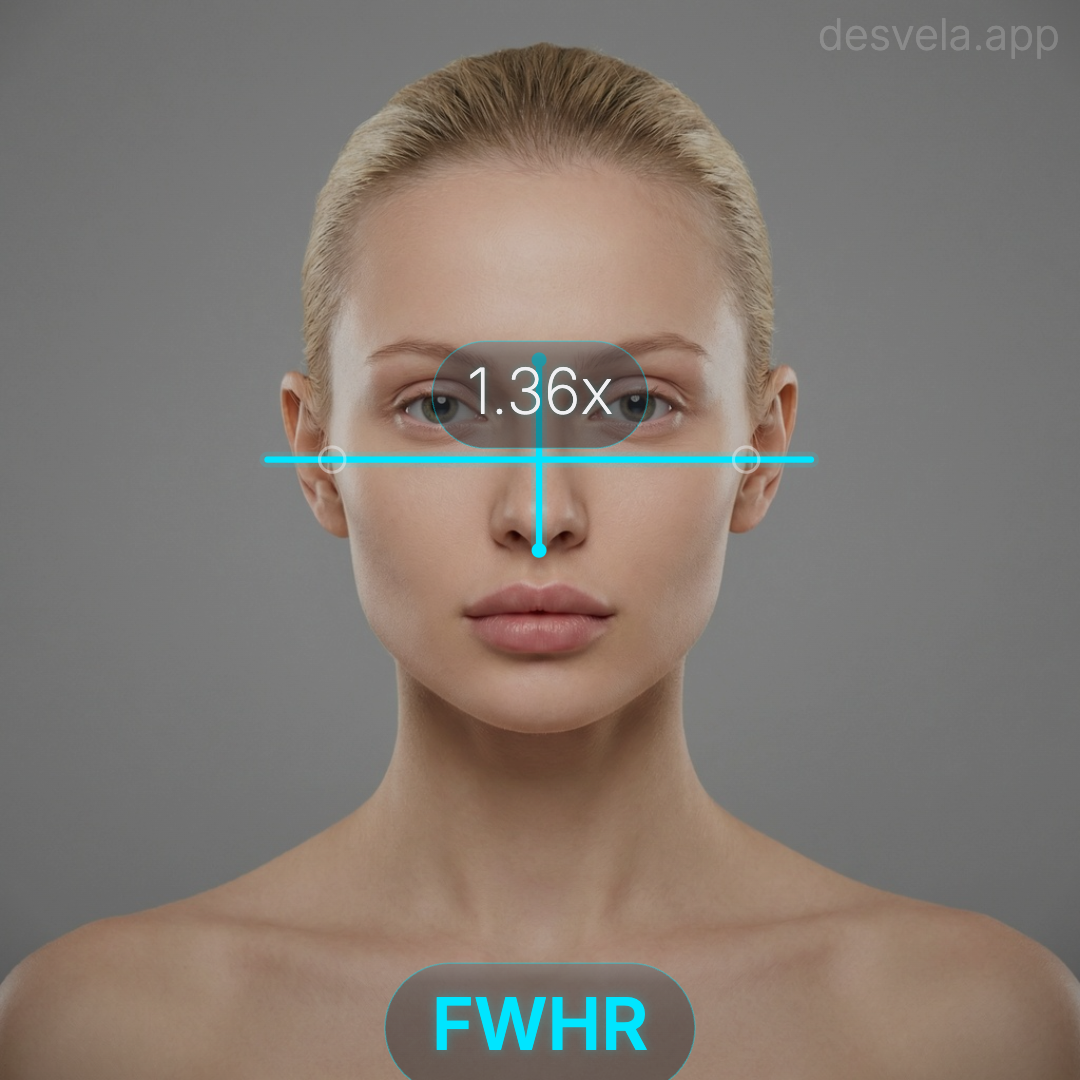
Face width-to-height ratio (fWHR) is exactly what it sounds like: the width of your face at the cheekbones divided by the height of the upper face (from the upper lip to the brow). It's a dimensionless ratio, typically falling between 1.6 and 2.2 for most adults.
The measurement was first systematically studied in the context of behavioral and social perception — not beauty. Researchers noticed that people with wider faces (higher fWHR) were perceived as more aggressive, dominant, and assertive, while narrower faces were perceived as more trustworthy and approachable.
fWHR and sexual dimorphism
The reason fWHR matters for facial analysis is its role as a sexual dimorphism marker. On average, men have higher fWHR values than women. Testosterone exposure during puberty drives wider zygomatic arches (cheekbones) and more robust facial structure, producing a wider face relative to its height.
For women, a lower fWHR is generally associated with higher femininity ratings. The "ideal" feminine face tends to be slightly narrower relative to its height, with delicate cheekbones and a tapered jawline. For men, a moderately high fWHR signals masculinity and physical robustness.
This is why fWHR is one of the four active metrics in Desvela's Zone 3 (Sexual Dimorphism), alongside canthal tilt, jaw taper, and chin angle. Together, these four measurements capture how strongly your face signals femininity or masculinity.
How is fWHR measured?
The standard measurement protocol uses two distances. Width is the maximum bizygomatic distance — the widest point across the cheekbones. Height is the distance from the upper lip (vermilion border) to the highest point of the brow.
Desvela calculates these distances using MediaPipe's facial landmarks. The width is measured between landmarks at the outer edges of the zygomatic arches, and the height is measured from the upper lip landmark to the mid-brow landmark. The ratio is then scored against ethnicity-calibrated baselines.
An important caveat: fWHR measured from photographs can vary with camera angle and lens distortion. Tilting the head up increases apparent fWHR; tilting down decreases it. Phone selfies taken at close range also distort the measurement due to perspective effects. Desvela's face-size gate helps catch the worst cases, but a front-facing photo at arm's length gives the most reliable result.
Ethnic variation in fWHR
fWHR varies significantly across populations. Wen et al. (2015) documented that Chinese adults have different fWHR distributions than White / European populations, with East Asian faces tending toward slightly higher fWHR on average. Black / African populations also show distinct patterns, as documented in Farkas et al.'s (2005) international anthropometric study.
This variation is exactly why a one-size-fits-all approach to scoring doesn't work. An fWHR of 1.85 might be perfectly average for one population but noticeably high for another. Desvela accounts for this by maintaining separate baseline means and standard deviations for each reference population.
The dominance perception research
Much of the early fWHR research focused on its connection to perceived aggression and dominance, particularly in men. Studies found that men with higher fWHR were rated as more aggressive, more likely to cheat in games, and more likely to be physically confrontational. Some researchers proposed this was a reliable "honest signal" of testosterone exposure.
More recent meta-analyses have tempered these claims. The effect sizes are small, and several replication attempts have produced mixed results. The relationship between fWHR and actual aggressive behavior is weaker than initially reported. However, the perceptual effect remains: people do judge wider faces as more dominant, even if this judgment isn't always accurate.
For women, the dominance perception is less relevant. The primary role of fWHR in female facial analysis is as a femininity marker — lower values signal more feminine facial structure.
What your fWHR score means in Desvela
Desvela scores fWHR within Zone 3 using the same Gaussian decay function applied to all metrics. Your score reflects how close your fWHR is to the feminine ideal for your reference population.
A high score means your face width-to-height ratio falls in the range associated with feminine attractiveness for your group. A low score indicates a higher-than-typical fWHR, which reads as more masculine or dominant.
Importantly, fWHR interacts with other Zone 3 metrics. A face with high fWHR but strong canthal tilt and a tapered jaw may still score well overall in dimorphism, because the other features compensate. This is why Desvela's zone scoring uses a weighted formula that considers both the average of all metrics and the weakest individual metric.
Can you change your fWHR?
fWHR is primarily skeletal — it's determined by your bone structure and is resistant to non-surgical modification. However, perceived fWHR can be influenced by styling and cosmetics. Contouring the cheekbones with bronzer narrows the apparent width. A hairstyle that adds height above the brow increases perceived upper face height, lowering perceived fWHR. Strategic highlighting along the center of the face draws the eye inward, reducing the impression of width.
These are exactly the kinds of recommendations Desvela generates in its protocol section. When your Zone 3 score is driven by fWHR, the protocols suggest specific contouring, hairstyle, and framing techniques to optimize the perceived ratio.
Key takeaways
fWHR is a simple ratio that carries a lot of perceptual weight. It signals sexual dimorphism more reliably than many other single metrics, varies significantly across ethnicities, and is one of the primary drivers of whether a face reads as feminine or masculine. While skeletal fWHR is fixed, perceived fWHR is surprisingly malleable through cosmetic and styling techniques.